Precipitation Forecast
— Excessive Rainfall
Office:
KWBC
Issued:
Sep 01, 2026 at 4:40 AM EDT
QPF
000
FOUS30 KWBC 010840
QPFERD

Excessive Rainfall Discussion
NWS Weather Prediction Center College Park MD
440 AM EDT Tue Sep 1 2026

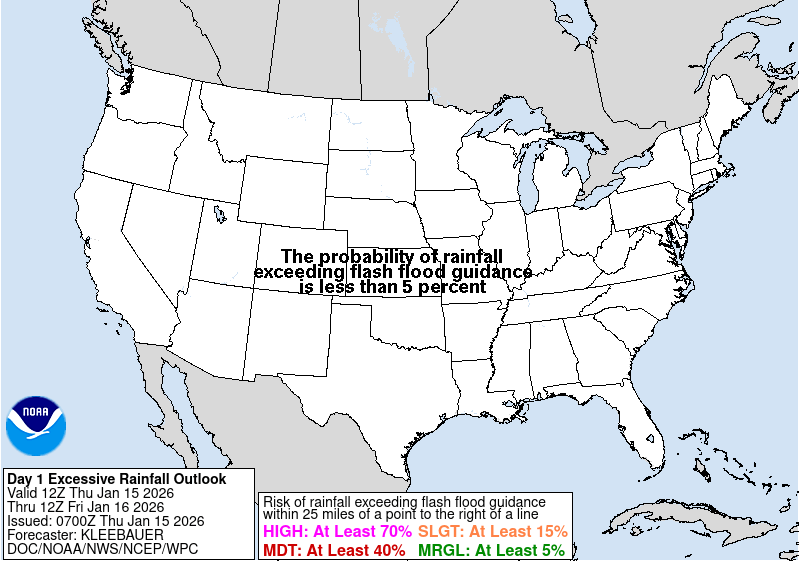
Day 1
Valid 12Z Tue Sep 01 2026 - 12Z Wed Sep 02 2026

...THERE IS A SLIGHT RISK OF EXCESSIVE RAINFALL FOR THE UPPER
TEXAS COAST AND FAR SOUTHWEST LOUISIANA...

...Central Gulf Coast...

NHC has forecast Tropical Storm Edouard to make landfall along the
Upper Texas Coast early in the period with a general consensus of
moving onshore very close to Galveston Bay before lifting slowly
NW through the afternoon and evening hours. The system is expected
to remain compact as it organizes and comes onshore, leading to a
narrow corridor of heavy rainfall thanks to PWs of over 2.25" in
the accompanying tropical moisture plume. While the heaviest rain
may occur along the coast and just NE of the center/track, there is
potential for some inflow convergence to maintain a corridor of
heavy rain even behind the system as it lifts into east-central
Texas. Additionally, the forecast movement (using latest NHC
forecast positions) is progged to only be around the 20th
percentile of Gulf Coast systems, suggesting the potential for
locally excessive rainfall where training is most pronounced and
prolonged.

Both the HREF and REFS ensemble suites indicate a high chance
(>70%) of at least 5" in a NW oriented stripe from Galveston Bay
through near College Station, with 8"/24hr probabilities exceeding
40% near the coast. This will continue to be monitored as the
storm evolves.

...Four Corners and Southwest...

After several days of heavy rain and substantial impacts across
the Four Corners and Southwest, activity is likely to wane
considerable today. Sufficient forcing and moisture for another
day of local impacts will be present, especially atop the
vulnerable soils impacted the last few days, thus maintaining a
Marginal Risk for much of the Four Corners.

Although PWs do come down, the drier air which has been progged to
push east has slowed down, leaving PW anomalies of +0.5 to +1
sigma in place on Tuesday. With significant forcing remaining in
place as a trough approaches from the west (leading to height
falls and jet level diffluence for synoptic ascent), this will
result in another day of at least scattered thunderstorm
development during peak heating, or within any enhanced lift
beneath weak impulses embedded within the flow. Mean 0-6km winds
will remain progressive at around 25 kts, but aligned propagation
vectors and continued elevated bulk shear magnitudes above 40 kts
will support organization into clusters and potentially repeating
cells. Hourly rainfall of 0.5 to 0.75 inches may occur.

...Great Lakes to the Northeast...

Mid-level impulses tracking atop the ridge and along a wavering
frontal boundary will continue to produce rounds of scattered
convection from the Great Lakes through New England and the
northern Mid- Atlantic states. As is typical with this convective
cluster setups, there is a lot of spread in both timing and
placement of the heaviest rain signatures from the available CAMs.
While the guidance is in good agreement that many areas will
receive periods of heavy rainfall exceeding 1"/hr as storms track
steadily WNW to ESE, the duration of any of this rain may be modest
due to the progressive nature of cells. However, short duration
training is likely at times thanks to aligned propagation
vectors/mean winds to the front, which could enhance rainfall
amounts locally.

In general, rainfall should be 1-2" which will only be sufficient
to create isolated impacts related to flash flooding, but if any
significant training/repeating could occur, locally higher rainfall
is possible. This is reflected by both HREF and REFS probabilities
for 3" that peak above 25%, especially across far southern New
England, Long Island, and northern PA/southern NY. However, due to
uncertainty in timing and placement, combined with generally
elevated FFG outside of the Catskills and Tri-State area, the
Marginal Risk was maintained.

...Florida...

Easterly flow will draw tropical moisture onshore helping to fuel
scattered afternoon convection. PW values will be nearing 2.25
inches and the mean flow across the Peninsula will be very weak
suggesting cells will drift west from the sea breeze, but may
converge just inland from the Gulf as the gulf breeze also pushes
inland. Some short term training will be possible (limited in
duration by the pulse nature of the cells) but with rainfall rates
expected to be 2-3"/hr, this could create isolated flash flood
impacts, especially within urban areas.

Campbell/Weiss


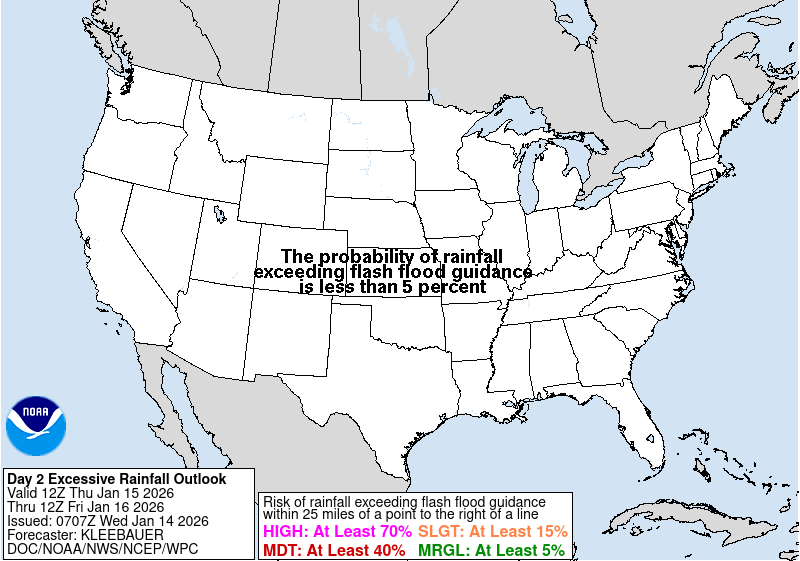
Day 2
Valid 12Z Wed Sep 02 2026 - 12Z Thu Sep 03 2026

...THERE IS A SLIGHT RISK OF EXCESSIVE RAINFALL FOR PARTS OF THE
NORTHEAST AND EASTERN TEXAS...

...Northern Mid Atlantic & Southern New England...

A Slight Risk remains in effect for much of central and eastern
new York. A stronger shortwave tracking atop the region to
interact with a slowly northeast advancing warm front will result
in scattered to widespread convection across the region. While the
exact location of the heaviest rainfall remains uncertain, there
should be amble support of training of clusters of thunderstorms
with 1-2"/hr rain rates. The guidance focuses this heaviest
rainfall across portions of Upstate New York, and while soil
moisture is generally below normal according to NASA SPoRT, this
should support up to 3" of rain in some areas leading to scattered
instances of flash flooding, with more isolated responses
elsewhere.

...Eastern Texas and Southwest Louisiana...

Tropical cyclone Edouard will be well inland and slowly its
progression while spread bands of heavy rainfall to eastern Texas
and into Louisiana. Additional heavy rainfall is likely even as the
central low pressure begins to dissipate. PWs of 2-2.25" will
support continued heavy rain, and as 850mb inflow only slowly
weakens it will drive enhanced convergence to support 2-3"/hr rain
rates. While most of the rain should be around the center of the
system which will be lifting slowly northward towards north Texas,
there is potential for a locally enhanced inflow band on its south
side which could prolong and enhance the rain across areas that
receive heavy rain. The small size of the storm should limit the
footprint and potential impacts, but ECENS/GEFS probabilities still
indicate that at least an additional 3" of rain may fall, with
locally higher amounts, leading to instances of flash flooding.
Some further refinements in the Slight Risk area are expected with
future updates, both to capture the latest guidance track, but
also better resolve where any additional rainfall will occur on top
of heavy rain from Tuesday.

...Northern Plains and Midwest...

Lingering MCS activity possible early in the period across the
Upper Midwest. PWAT anomalies remain elevated at times mid- week,
with values of 1.5-2" forecast, however the spread in the
deterministic QPF is higher than average. A broad Marginal Risk
spans from Minnesota/Iowa eastward to the Great Lakes.

...Florida...

Another day where the tropical moisture plume remains entrenched
across Florida, reflected by PW anomalies of +1.5 sigma stretching
across most of the state. Both coasts could experience slow moving
storms with 2+"/hr rain rates, as well as across the inland
portions of the peninsula where storm mergers/collisions can occur.
A Marginal Risk was maintained for this period.

Campbell/Weiss


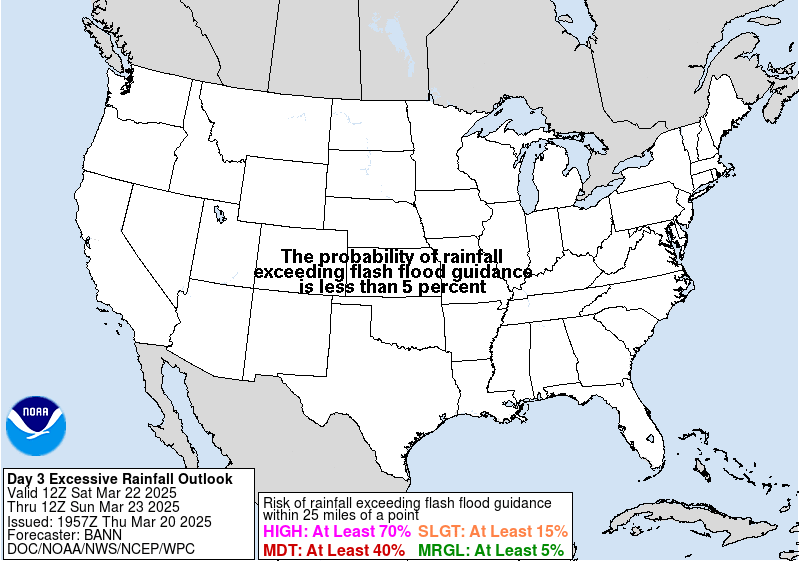
Day 3
Valid 12Z Wed Sep 02 2026 - 12Z Thu Sep 03 2026

...THERE IS A SLIGHT RISK OF EXCESSIVE RAINFALL FOR PARTS OF THE
NORTHEAST AND EASTERN TEXAS...

...Northern Mid Atlantic & Southern New England...
Small adjustments were made to the inherited SLGT risk to account
for the latest guidance. While the setup Wednesday is at least
synoptically similar to both Monday and Tuesday, a more impressive
shortwave tracking atop the region to interact with a slowly
northeast advancing warm front will result in scattered to
widespread convection. There is still some uncertainty as to the
placement of the heaviest rainfall, but an improving warm sector
with favorable thermodynamics along a sharp gradient should support
training of clusters of thunderstorms with 1-2"/hr rain rates. The
guidance focuses this heaviest rainfall across portions of Upstate
New York, and while soil moisture is generally below normal
according to NASA SPoRT, this should support up to 3" of rain in
some areas leading to scattered instances of flash flooding, with
more isolated responses elsewhere.

...Eastern Texas and Southwest Louisiana...
Tropical Depression 5 will be well inland by the start of the
forecast period, but with slow movement expected to continue,
additional heavy rainfall is likely even as it begins to dissipate.
PWs of 2-2.25" will support continued heavy rain, and as 850mb
inflow only slowly weakens it will drive enhanced convergence to
support 2-3"/hr rain rates. While most of the rain should be around
the center of the system which will be lifting slowly northward
towards north Texas, there is potential for a locally enhanced
inflow band on its south side which could prolong and enhance the
rain across areas that receive heavy rain on Tuesday as well. The
small size of the storm should limit the footprint and potential
impacts, but ECENS/GEFS probabilities still indicate that at least
an additional 3" of rain may fall, with locally higher amounts,
leading to instances of flash flooding. Some further refinements in
the SLGT risk area are expected with future updates, both to
capture the latest guidance track, but also better resolve where
any additional rainfall will occur on top of heavy rain from
Tuesday.

...Northern Plains and Midwest...
Lingering MCS activity possible early in the period across the
Upper Midwest. PWAT anomalies remain elevated at times mid- week,
with values of 1.5-2" forecast, however the spread in the
deterministic QPF is higher than average. A broad Marginal Risk
spans from Minnesota/Iowa eastward to the Great Lakes.

...Florida...
Another day where the tropical moisture plume remains entrenched
across Florida, reflected by PW anomalies of +1.5 sigma stretching
across most of the state. The biggest change from prior days, at
least as modeled in guidance, is weaker overall flow leading to
slower storm motions, and a better chance for both coasts to
experience slow moving storms with 2+"/hr rain rates, as well as
across the inland portions of the peninsula where storm
mergers/collisions can occur. After coordination, the inherited
MRGL risk was expanded to cover the entire Peninsula south of
Jacksonville, with the greatest risk for impacts occurring atop
urban areas.

Weiss/Campbell


Day 4 and Day 5

Valid 12Z Fri Sep 04 2026 - 12Z Sun Sep 06 2026

...THERE IS A SLIGHT RISK OF EXCESSIVE RAINFALL FRIDAY ACROSS
PORTIONS OF ARIZONA...

...Southwest/Four Corners/Central-Southern Rockies...

The signal for the return of heavy rain areas across the Southwest
into the Four Corners and central-southern Rockies remains strong
both Friday and Saturday, especially Friday across central to
southeast AZ where a Slight Risk area remains from yesterday's Day
5 ERO. GEFS and ECENS PWAT anomalies increase back to 2-2.5
standard deviations above normal both Fri and Sat, however the
deterministic and probabilistic QPFs per the GEFS, EC, and CMC
ensembles are more supportive of the Slight Risk on Day 4 (Fri-Fri
night), with the axis of best monsoonal moisture influx shifting
slightly west next weekend. Still remains to be seen how much
influence the eventual tropical system that ultimately pulls west
of Baja will have in terms of the upper level moisture (potential
uptick in the PWAT anomaly( by Friday and over the weekend. The GFS
remains too far east with the track of this feature compared to
the rest of the global guidance, and it continues to trend towards
the ECMWF and CMC suites.

...Northern Great Basin/Northern Rockies...

Marginal Risk area from yesterday's Day 5 ERO continues in the new
Day 4 outlook across portions of the interior Northwest,
particularly the area surrounding the northern Idaho Panhandle.
This area will be much closer to the upper level trough, so forcing
should be much better than in the Southwest. However, moisture and
instability will be much lower, resulting in more likelihood of
stratiform rainfall. Despite this, the rainfall should still have
modest amounts of instability to work with in a generally dry, and
therefore flash flood prone, area of the country.

...Upper Midwest/Ohio Valley/Central Appalachians...

Despite the current spatial and temporal spread with the current
(00Z 9/1) guidance suite, expect more organized/widespread
convection on Friday downwind of the upper ridge axis. This will
likely start over eastern portions of the Upper Midwest, where the
upper jet streak to the northeast is expected to strengthen as the
pivoting northern stream trough impinges on the broad-scale ridge
to the south. Have essentially traced the Marginal Risk area
southeast along the mean 850-300 mb thickness fields, where the
upper level forcing along/ahead of the surface front will be most
supportive of more organized activity.

Hurley


Day 1 threat area: https://www.wpc.ncep.noaa.gov/qpf/94epoints.txt
Day 2 threat area: https://www.wpc.ncep.noaa.gov/qpf/98epoints.txt
Day 3 threat area: https://www.wpc.ncep.noaa.gov/qpf/99epoints.txt

$$