Convective Outlook
— Day 4-8
Wednesday/Day 4 To Thursday/Day 5 ?
On Wednesday, model forecasts continue to move a mid-level shortwave trough across the southern Plains. A cold front is forecast to advance southeastward into Oklahoma as a moist and unstable airmass resides southward from the front over much of the southern Plains. Surface dewpoints across southeast Oklahoma and north-central to northeast Texas should be in the lower to mid 60s F, and moderate instability will be possible by afternoon. Thunderstorm development appears likely across parts of this unstable airmass from the mid afternoon into the evening. Moderate deep-layer shear should support a severe threat, with a potential for large hail and damaging wind gusts associated with supercells.
On Thursday, the shortwave trough is forecast to move into the mid Mississippi Valley, as a much larger upper-level trough moves through the Desert Southwest. A moist and unstable airmass should remain in place over the southern Plains. However, large-scale ascent should be weak between these two systems, which should dampen the severe potential across most of the south-central U.S. The most likely location for an isolated to marginal severe threat would be in the Ark-La-Tex Thursday afternoon.
Friday/Day 6 To Sunday/Day 8 ?
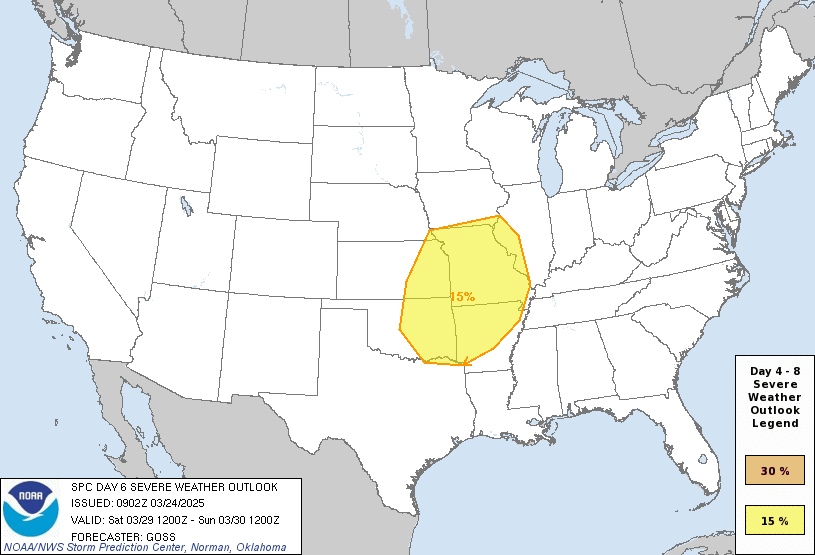
At mid-levels, southwest flow is forecast across much of the central U.S. on Friday, as a large trough remains over the southwestern states. Moisture advection is expected to continue over the Great Plains and Upper Midwest along a corridor of strong low-level flow. Model forecasts are in general agreement that moderate instability will develop over much of this airmass by Friday afternoon, and that scattered thunderstorms will form. Convective development will be supported by the right entrance region of a mid-level jet ejecting northeastward through the central Plains. This mid-level jet will be associated with moderate to strong deep-layer shear, supporting scattered severe storms potentially across a large part of the moist sector. The current thinking is that the severe threat will be maximized during the late afternoon and evening from central Texas northeastward into the lower Missouri Valley. Large hail and damaging wind gusts are expected to the primary threats, but a few tornadoes remain possible.
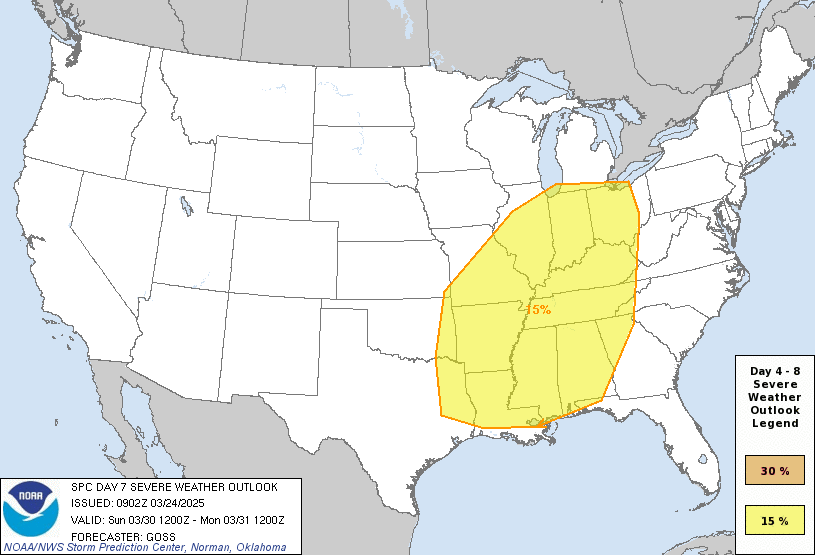
On Saturday, the upper-level system in the central U.S. is forecast to move into the Great Lakes region, as a cold front advances quickly southeastward into the western Gulf Coast states, and lower Mississippi Valley. An isolated severe threat could develop ahead of the front Saturday afternoon, but confidence is low concerning the spatial distribution of any threat. On Sunday, isolated to scattered thunderstorms will again be possible in the Gulf Coast region. However, deep-layer shear is forecast to be weak over much of this area, suggesting any severe potential should remain marginal.
000
ACUS48 KWNS 011001
SWOD48
SPC AC 010959

Day 4-8 Convective Outlook
NWS Storm Prediction Center Norman OK
0359 AM CST Sun Mar 01 2026

Valid 041200Z - 091200Z

...DISCUSSION...
...Wednesday/Day 4 to Thursday/Day 5...
On Wednesday, model forecasts continue to move a mid-level shortwave
trough across the southern Plains. A cold front is forecast to
advance southeastward into Oklahoma as a moist and unstable airmass
resides southward from the front over much of the southern Plains.
Surface dewpoints across southeast Oklahoma and north-central to
northeast Texas should be in the lower to mid 60s F, and moderate
instability will be possible by afternoon. Thunderstorm development
appears likely across parts of this unstable airmass from the mid
afternoon into the evening. Moderate deep-layer shear should support
a severe threat, with a potential for large hail and damaging wind
gusts associated with supercells.

On Thursday, the shortwave trough is forecast to move into the mid
Mississippi Valley, as a much larger upper-level trough moves
through the Desert Southwest. A moist and unstable airmass should
remain in place over the southern Plains. However, large-scale
ascent should be weak between these two systems, which should dampen
the severe potential across most of the south-central U.S. The most
likely location for an isolated to marginal severe threat would be
in the Ark-La-Tex Thursday afternoon.

...Friday/Day 6 to Sunday/Day 8...
At mid-levels, southwest flow is forecast across much of the central
U.S. on Friday, as a large trough remains over the southwestern
states. Moisture advection is expected to continue over the Great
Plains and Upper Midwest along a corridor of strong low-level flow.
Model forecasts are in general agreement that moderate instability
will develop over much of this airmass by Friday afternoon, and that
scattered thunderstorms will form. Convective development will be
supported by the right entrance region of a mid-level jet ejecting
northeastward through the central Plains. This mid-level jet will be
associated with moderate to strong deep-layer shear, supporting
scattered severe storms potentially across a large part of the moist
sector. The current thinking is that the severe threat will be
maximized during the late afternoon and evening from central Texas
northeastward into the lower Missouri Valley. Large hail and
damaging wind gusts are expected to the primary threats, but a few
tornadoes remain possible.

On Saturday, the upper-level system in the central U.S. is forecast
to move into the Great Lakes region, as a cold front advances
quickly southeastward into the western Gulf Coast states, and lower
Mississippi Valley. An isolated severe threat could develop ahead of
the front Saturday afternoon, but confidence is low concerning the
spatial distribution of any threat. On Sunday, isolated to scattered
thunderstorms will again be possible in the Gulf Coast region.
However, deep-layer shear is forecast to be weak over much of this
area, suggesting any severe potential should remain marginal.

..Broyles.. 03/01/2026